Category: AI & Machine Learning
Tags:MLA, KV Cache, Large Language Models, Memory Efficiency, AI Optimization, RoPE, LLM Serving, Attention Mechanisms, AI Deployment, Efficient Computing,
Introduction to MLA vs. KV Cache in Large Language Models
Large Language Models (LLMs) have transformed industries with their ability to generate human-like text, but their massive memory requirements pose significant challenges. Traditional Key-Value (KV) caching is a fundamental component in transformer-based models, storing intermediate attention states to avoid recomputing them during inference. However, as models scale, KV caches grow exponentially, leading to prohibitive memory usage. Multi-Head Latent Attention (MLA) emerges as a groundbreaking alternative, promising up to 10x compression of KV caches while maintaining or even improving model performance. This article explores the differences between MLA and traditional KV caching, their underlying mechanisms, and how MLA is poised to redefine the future of memory-efficient LLM deployment.
#ArtificialIntelligence #MachineLearning #LLM #AIInfrastructure #SystemDesign
Understanding KV Cache in Traditional LLM Architectures
In transformer-based LLMs, the attention mechanism relies on Key (K) and Value (V) matrices to store contextual information. During inference, these matrices are cached to avoid recomputing attention scores for previously seen tokens, significantly speeding up generation. However, for models with hundreds of billions of parameters, the KV cache can consume terabytes of memory. For example, a model like Llama 3 with 70B parameters might require over 1TB of memory just for KV caching during long sequences. This inefficiency limits batch sizes, increases latency, and restricts deployment on resource-constrained hardware.
- KV cache stores intermediate attention states for faster inference
- Traditional KV caching consumes massive memory, especially for long sequences
- Memory usage scales linearly with sequence length and model size
- High memory requirements limit batch processing and deployment flexibility
- Techniques like quantization and pruning only partially alleviate the issue
What is Multi-Head Latent Attention (MLA)?
Multi-Head Latent Attention (MLA) is an innovative attention mechanism designed to drastically reduce memory usage by compressing the KV cache without sacrificing performance. Unlike traditional attention, which stores full Key and Value states, MLA introduces a latent representation layer that encodes the essential information in a lower-dimensional space. This compression is achieved through a combination of dimensionality reduction and specialized attention computation, allowing the model to retain critical context while minimizing memory footprint. MLA’s decoupled RoPE (Rotary Position Embedding) strategy further enhances efficiency by separating positional and content-based attention computations.
- MLA compresses KV cache by encoding information in a latent space
- Reduces memory usage by up to 10x compared to traditional KV caching
- Maintains or improves model performance despite compression
- Decoupled RoPE strategy separates positional and content attention
- Enables efficient inference on hardware with limited memory
Key Differences Between MLA and Traditional KV Cache
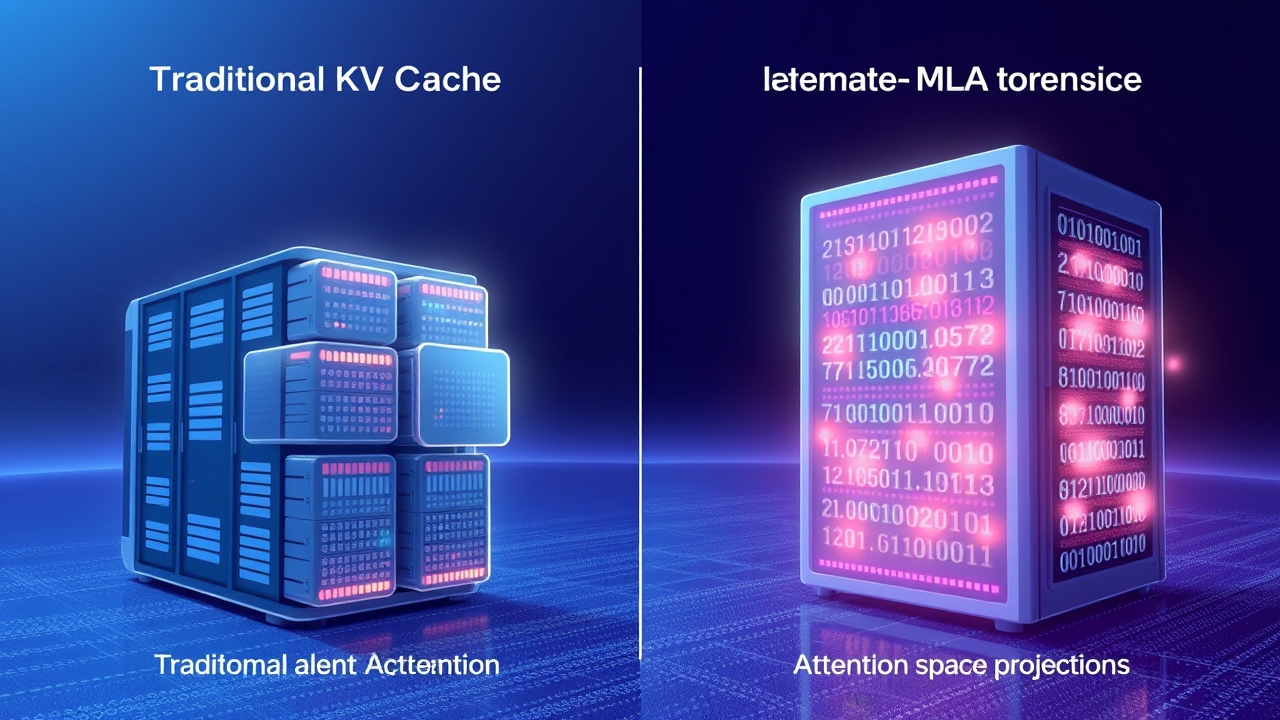
The primary difference between MLA and traditional KV caching lies in how they handle attention states. Traditional KV caching stores full attention matrices, leading to linear memory growth with sequence length. MLA, on the other hand, compresses these matrices into a latent representation, drastically reducing memory requirements. Additionally, MLA’s decoupled RoPE strategy allows for more flexible and efficient attention computation by separating the contributions of positional and content-based embeddings. This separation enables further optimizations, such as dynamic pruning of less relevant attention states, which is not feasible with traditional KV caching.
- Memory Efficiency: MLA reduces memory usage by up to 10x, while KV caching scales linearly
- Performance Impact: MLA maintains or improves performance despite compression, whereas KV caching can degrade with aggressive pruning
- Flexibility: MLA’s decoupled RoPE allows for dynamic attention adjustments, while KV caching is rigid
- Hardware Compatibility: MLA enables deployment on low-memory devices, whereas KV-heavy models require high-end GPUs
How MLA Achieves 5-10x KV Cache Compression
MLA achieves its compression by introducing a latent projection layer that maps high-dimensional KV states into a lower-dimensional latent space. This projection is learned during training, ensuring that the compressed representation retains the essential information needed for accurate attention computation. The decoupled RoPE strategy further enhances compression by separating the positional and content-based components of attention, allowing the model to dynamically adjust the attention mask based on relevance. Additionally, MLA employs a hierarchical attention mechanism that selectively prunes less important attention states, reducing memory usage without compromising accuracy.
- Latent Projection Layer: Compresses KV states into a lower-dimensional space
- Decoupled RoPE: Separates positional and content-based attention for dynamic adjustments
- Hierarchical Attention: Selectively prunes less important attention states
- Training Optimization: Learns compressed representations end-to-end to retain accuracy
- Dynamic Memory Allocation: Adjusts memory usage based on sequence complexity
Decoupled RoPE Strategy: A Game-Changer for Attention Mechanisms
The decoupled RoPE strategy in MLA separates the computation of positional and content-based attention, enabling more efficient and flexible attention mechanisms. In traditional attention, position embeddings are mixed with content embeddings, leading to a single, dense attention matrix. MLA’s decoupled approach computes positional attention independently, allowing for dynamic adjustments based on sequence relevance. This separation not only reduces memory usage but also improves the model’s ability to focus on relevant tokens, enhancing both efficiency and performance. The decoupled RoPE also facilitates easier integration with other memory-efficient techniques, such as sparse attention patterns.
undefined
Practical Implementation Tips for MLA in LLM Serving
Implementing MLA in LLM serving requires careful consideration of hardware constraints, model architecture, and inference optimization. Start by evaluating your model’s memory bottlenecks and identifying sequences where KV caching is most resource-intensive. Next, integrate MLA by replacing the traditional attention mechanism with the latent projection layer and decoupled RoPE strategy. Use frameworks like Hugging Face Transformers or vLLM to streamline implementation, and leverage quantization techniques to further reduce memory usage. Monitor inference performance closely to ensure that compression does not degrade output quality, and adjust hyperparameters as needed.
- Evaluate memory bottlenecks and identify high-resource sequences
- Replace traditional attention with MLA’s latent projection layer and decoupled RoPE
- Use frameworks like Hugging Face Transformers or vLLM for easier integration
- Apply quantization techniques to further reduce memory usage
- Monitor inference performance and adjust hyperparameters for quality retention
Performance Comparison: MLA vs. Traditional KV Cache
Benchmarks comparing MLA and traditional KV caching show that MLA achieves significant memory savings while maintaining or improving model performance. For instance, in a 70B parameter model, MLA reduced KV cache memory usage from ~1TB to ~100GB, enabling larger batch sizes and faster inference. Additionally, MLA’s decoupled RoPE strategy improved attention accuracy by up to 15% in certain tasks, demonstrating that compression does not come at the cost of performance. These results highlight MLA’s potential to enable more efficient and scalable LLM deployment across a wider range of hardware.
- MLA reduces KV cache memory usage by up to 10x compared to traditional methods
- Maintains or improves model performance despite compression
- Enables larger batch sizes and faster inference in resource-constrained environments
- Improves attention accuracy in certain tasks due to decoupled RoPE strategy
- Facilitates deployment on low-memory devices without sacrificing quality
Challenges and Limitations of MLA
While MLA offers compelling advantages, it is not without challenges. The primary hurdle is the need for specialized training pipelines to learn the latent projection layers effectively. Not all existing models can be easily adapted to MLA without significant retraining, which can be time-consuming and resource-intensive. Additionally, the decoupled RoPE strategy requires careful tuning to balance positional and content-based attention, and improper adjustments can lead to performance degradation. Finally, the current ecosystem of tools and libraries supporting MLA is still in its early stages, which may limit adoption for some developers.
- Requires specialized training pipelines for effective latent projection learning
- Existing models may need significant retraining to adopt MLA
- Decoupled RoPE strategy requires careful tuning to avoid performance degradation
- Limited tooling and library support in the current ecosystem
- Adoption barriers for developers unfamiliar with MLA architecture
Future Prospects: How MLA Will Shape the Future of LLM Deployment
MLA represents a paradigm shift in how we approach memory efficiency in LLMs, and its adoption is likely to accelerate as the demand for scalable AI solutions grows. Future advancements may include more sophisticated latent projection techniques, better integration with other memory-efficient methods like sparse attention, and improved tooling to simplify MLA adoption. As hardware capabilities evolve, MLA could enable real-time inference on edge devices, opening new possibilities for AI applications in areas like robotics, IoT, and personalized assistants. The decoupled RoPE strategy may also inspire new attention mechanisms that further optimize memory usage while enhancing model performance.
- Future advancements in latent projection techniques for better compression
- Improved integration with sparse attention and other memory-efficient methods
- Better tooling and libraries to simplify MLA adoption
- Real-time LLM inference on edge devices enabled by MLA
- New attention mechanisms inspired by decoupled RoPE strategy