Category: Technology & Programming
Tags:AI agent orchestration, pub/sub system, Rust programming, scalable architecture, event-driven systems, low-latency systems, backpressure handling, idempotency patterns, real-time data processing, high-performance computing,
AI agent orchestration demands a robust communication backbone that can handle high-throughput, low-latency event streams without compromising reliability. Building such a system from scratch in Rust offers unparalleled control over performance, memory safety, and concurrency, making it the ideal choice for mission-critical AI applications. This guide walks you through designing a scalable pub/sub architecture tailored for AI agents, emphasizing durability, real-time processing, and operational simplicity—all without relying on external message brokers like Kafka or RabbitMQ.
#AIAgents #Rust #DistributedSystems #SystemDesign #BackendDevelopment #Softved
Why Rust for Pub/Sub Systems?
Rust’s zero-cost abstractions, fearless concurrency, and strict compile-time guarantees make it the perfect language for building high-performance pub/sub pipelines. Unlike interpreted languages, Rust compiles to native code, reducing latency and maximizing throughput. Its ownership model ensures thread safety without runtime overhead, while its powerful type system prevents data races and null pointer exceptions. These features are critical when designing systems that must handle millions of messages per second with sub-millisecond latency.
- Memory safety guarantees eliminate common bugs like buffer overflows and data races.
- Zero-cost abstractions ensure that high-level constructs compile to efficient machine code.
- Fearless concurrency allows safe parallel processing without runtime overhead.
- Minimal runtime footprint reduces latency in real-time systems.
- Strong typing and compile-time checks catch errors before runtime.
Core Components of a Scalable Pub/Sub Pipeline
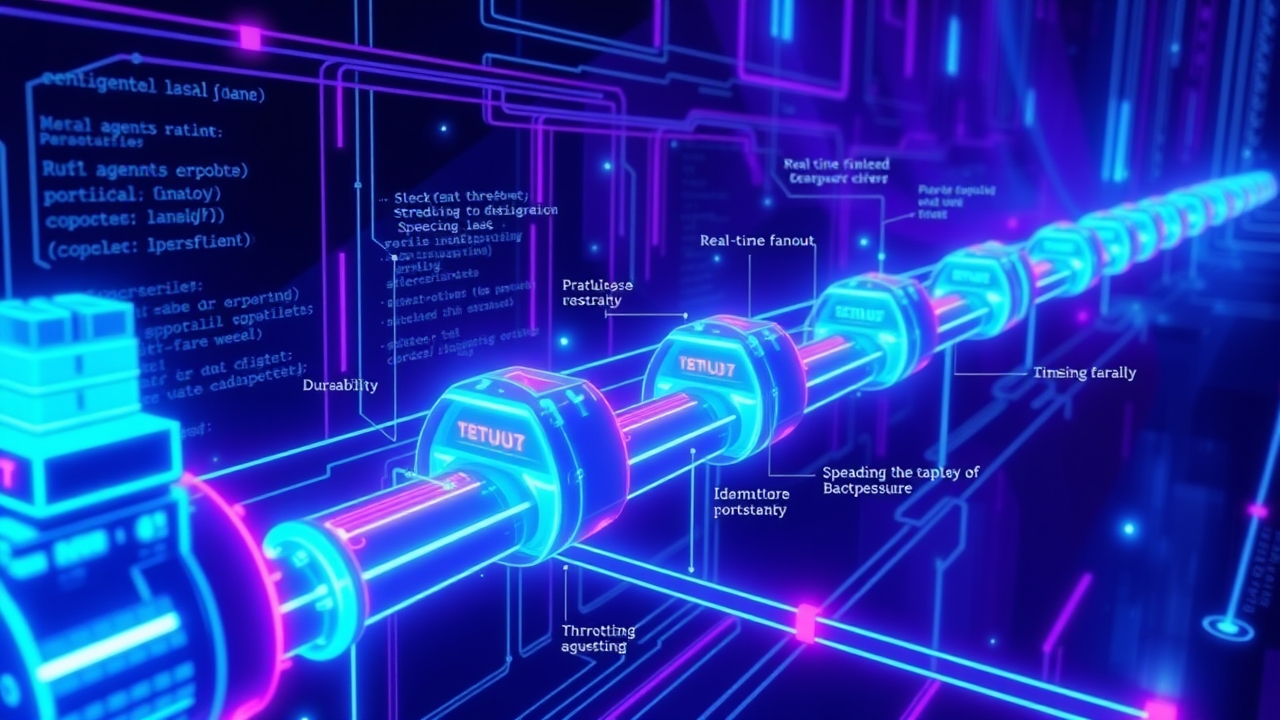
A well-designed pub/sub system consists of several key components that work together to ensure durability, scalability, and real-time performance. In this section, we break down each component and explain how they integrate into a cohesive architecture. From message brokers and event logs to subscriber fanout and backpressure handling, every element plays a crucial role in maintaining system reliability under load.
1. Durable Event Streams: The Backbone of Reliability
At the heart of any pub/sub system lies the event log—a persistent, ordered sequence of messages that guarantees no data loss even in the face of failures. In Rust, implementing a durable event stream involves leveraging memory-mapped files or append-only databases to achieve high write throughput with low overhead. By using techniques like write-ahead logging (WAL) and segment-based storage, you can ensure that messages are durably persisted before being acknowledged to publishers. This approach not only prevents data loss but also enables fast recovery in case of crashes.
- Use memory-mapped files for low-latency disk I/O with minimal overhead.
- Implement segment-based storage to limit the size of individual log files and simplify compaction.
- Leverage write-ahead logging (WAL) to ensure durability before acknowledging messages.
- Apply checksums and sequence numbers to detect corruption and maintain order.
- Design for crash consistency to recover quickly without data loss.
2. Real-Time Fanout: Efficiently Distributing Messages to Subscribers
Once messages are durably stored, they need to be efficiently distributed to subscribers without introducing latency spikes. Real-time fanout in Rust can be achieved using shared memory channels or lock-free data structures, allowing multiple subscribers to process messages concurrently without blocking. Techniques like batching and pre-fetching can further optimize throughput, while backpressure mechanisms ensure that fast publishers don’t overwhelm slower subscribers. This balance between speed and fairness is essential for maintaining system stability under varying loads.
- Use shared memory channels or lock-free queues for low-latency fanout.
- Implement batching to reduce per-message overhead and improve throughput.
- Apply backpressure to prevent overwhelming slow subscribers.
- Design subscriber groups to parallelize processing across CPU cores.
- Monitor fanout latency to identify bottlenecks in real time.
3. Idempotency: Ensuring Exactly-Once Processing Semantics
In distributed systems, duplicate messages can lead to inconsistent states or wasted resources. Idempotency ensures that processing a message multiple times yields the same result as processing it once, which is critical for AI workloads where stateful agents must maintain accurate knowledge. In Rust, you can implement idempotency using unique message IDs, deduplication caches, or deterministic processing logic. Combining these techniques with a durable event log creates a system where even retries or failures don’t compromise correctness.
- Assign unique IDs to every message to track and deduplicate processing.
- Use in-memory or disk-based caches to store processed message IDs for quick lookup.
- Implement deterministic processing logic to ensure the same input always produces the same output.
- Leverage the event log to replay messages safely without duplication.
- Combine idempotency with checkpointing for stateful agents.
4. Backpressure Management: Handling Uneven Loads Gracefully
AI workloads often exhibit bursty behavior, with publishers generating messages faster than subscribers can process them. Backpressure is the mechanism that prevents system overload by dynamically throttling publishers when necessary. In Rust, you can implement backpressure using bounded channels, rate limiting, or adaptive flow control algorithms like the token bucket. These techniques ensure that the system remains stable under load while providing feedback to publishers about their current throughput limits.
- Use bounded channels to block publishers when subscribers can’t keep up.
- Implement rate limiting to cap message production during peak loads.
- Apply adaptive flow control algorithms like token bucket or leaky bucket.
- Monitor queue depths to detect and respond to backpressure events.
- Expose backpressure metrics to publishers for dynamic adjustment.
5. Observability and Benchmarking: Measuring Performance Under Load
A pub/sub system without observability is a black box—you can’t optimize what you can’t measure. Rust’s ecosystem provides excellent tools for monitoring performance, including lightweight metrics libraries like Prometheus exporters, distributed tracing with Jaeger, and custom profiling with perf or flamegraph. Benchmarking is equally critical; tools like criterion.rs or custom load testers can simulate real-world workloads to identify bottlenecks in latency, throughput, or resource usage. By combining observability with benchmarking, you gain the insights needed to fine-tune your system for peak performance.
- Integrate Prometheus exporters to expose key metrics like latency and throughput.
- Use Jaeger for distributed tracing to track message flow across components.
- Leverage criterion.rs for microbenchmarking critical paths in your system.
- Profile with perf or flamegraph to identify CPU bottlenecks.
- Simulate real-world workloads to stress-test your pub/sub pipeline.
6. Trade-Offs and Optimizations: Finding the Right Balance
Building a pub/sub system involves navigating a web of trade-offs between latency, throughput, durability, and resource usage. For example, increasing batch sizes can improve throughput but may introduce additional latency. Similarly, using more durable storage guarantees durability but can reduce write performance. In Rust, you can fine-tune these trade-offs by adjusting parameters like segment sizes, batch intervals, or concurrency levels. The key is to profile your system under realistic workloads and iterate based on empirical data.
- Balance batch size against latency requirements for optimal throughput.
- Adjust segment sizes to trade durability for write performance.
- Tune concurrency levels to maximize CPU utilization without overloading the system.
- Experiment with different storage backends (e.g., SSD vs. NVMe) for your event log.
- Iterate based on real-world benchmarks to find the sweet spot for your use case.
Benchmarking Your Rust Pub/Sub Pipeline
Benchmarking is essential to validate your design choices and uncover hidden bottlenecks. In Rust, you can write custom load testers using tokio for asynchronous I/O or leverage existing tools like wrk2 for HTTP-based benchmarking. Focus on metrics like end-to-end latency, messages per second, and resource utilization under varying loads. Compare your Rust-based system against external brokers like Kafka to quantify the performance benefits of building your own pipeline. These benchmarks will not only prove your system’s capabilities but also guide further optimizations.
- Use tokio for asynchronous load testing to simulate real-world AI workloads.
- Leverage wrk2 to generate high-throughput message streams for benchmarking.
- Measure end-to-end latency, throughput, and resource usage under load.
- Compare performance against Kafka or RabbitMQ to highlight Rust’s advantages.
- Document benchmarks to track improvements and regressions over time.
Deploying Your Pub/Sub System for AI Agents
Once your pub/sub pipeline is built and benchmarked, the next step is deployment. Rust’s compiled binaries make deployment straightforward, whether you’re running the system on bare metal, in containers, or as part of a Kubernetes cluster. For AI agents, consider deploying the pub/sub system as a sidecar or shared service to maximize resource efficiency. Use configuration management tools like Ansible or Terraform to automate deployments, and implement health checks to ensure the system remains operational during updates or failures.
- Compile to a single binary for easy deployment across environments.
- Deploy as a sidecar or shared service to optimize resource usage for AI agents.
- Use Ansible or Terraform for automated, reproducible deployments.
- Implement health checks and rolling updates to minimize downtime.
- Monitor the system post-deployment to catch issues early.
Conclusion: Building a Future-Proof Pub/Sub Pipeline in Rust
Designing a scalable pub/sub pipeline for AI agents in Rust is a rewarding challenge that combines systems programming with real-time data processing. By focusing on durability, real-time fanout, idempotency, backpressure, and observability, you can build a system that handles the demands of modern AI workloads without external dependencies. The benchmarks and trade-offs discussed in this guide provide a roadmap for optimizing your pipeline, while Rust’s performance and safety guarantees ensure that your system remains reliable under pressure. Whether you’re building a new AI orchestration platform or modernizing an existing one, Rust’s pub/sub pipeline offers a powerful foundation for the future.