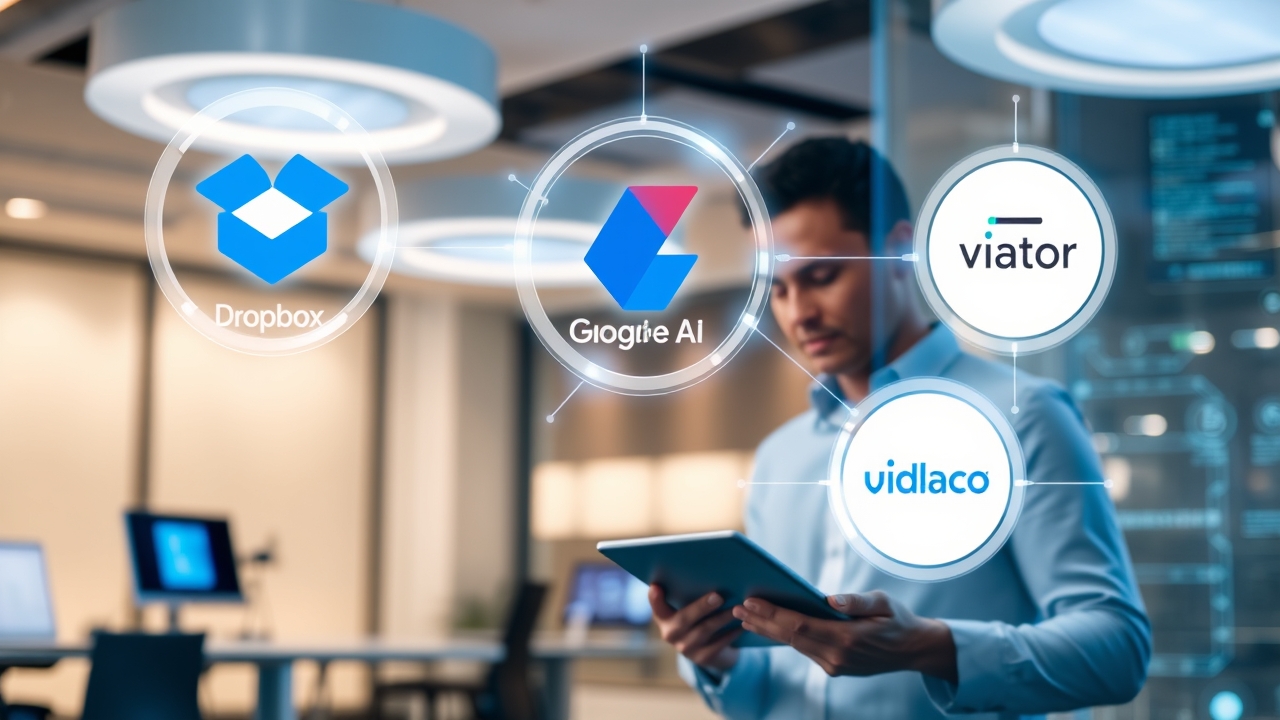
Introduction: The Rise of AI-Powered Automation
Artificial Intelligence has evolved from a futuristic concept to a cornerstone of modern business operations. Traditional automation relied heavily on rigid APIs and manual integrations, often creating bottlenecks and inefficiencies. However, Google’s latest advancements in AI assistants are changing the game by introducing multi-context connected apps that dynamically adapt to real-world workflows. These integrations go beyond static API calls, enabling seamless interactions between disparate systems like Dropbox, Zillow, and Viator. The result is a more fluid, intelligent automation ecosystem that reduces human intervention while enhancing productivity and accuracy.
Understanding Google’s Multi-Context AI Assistants
Google’s multi-context AI assistants are designed to understand and act within complex, interconnected environments. Unlike traditional AI tools that operate in isolated silos, these assistants leverage advanced natural language processing (NLP) and machine learning to interpret context across multiple applications. For example, an assistant might simultaneously analyze a file in Dropbox, a booking request in Zillow, and a travel itinerary in Viator to suggest optimal actions. This contextual awareness reduces errors and ensures that automation aligns with real-time user needs, making workflows more intuitive and efficient.
Seamless Integration with Dropbox: Revolutionizing File Management
Dropbox has long been a leader in cloud-based file management, but its integration with Google’s AI assistants takes efficiency to the next level. Users can now automate repetitive tasks such as file categorization, sharing permissions, and version control without manual input. For instance, an AI assistant can automatically organize files based on their content, suggest collaborators for shared documents, and even flag potential security risks. This level of automation not only saves time but also minimizes human errors, ensuring that files are always up-to-date and accessible.
- Automated file categorization based on content analysis
- Dynamic sharing permissions for team collaboration
- Real-time version control and conflict resolution
- AI-driven security checks for sensitive documents
- Integration with Google Workspace for unified workflows
Zillow Integration: Streamlining Consumer Bookings and Data Access
Zillow’s partnership with Google’s AI assistants is transforming how consumers and businesses interact with real estate data. AI assistants can now pull and analyze property listings, mortgage rates, and neighborhood statistics in real time, providing users with actionable insights. For businesses, this means automated lead generation, personalized property recommendations, and even predictive analytics for market trends. Consumers benefit from AI-driven tools that simplify the home-buying process, such as instant mortgage pre-approvals and automated scheduling for property viewings. This integration bridges the gap between data and decision-making, making complex real estate transactions more manageable.
- Real-time property listing analysis and recommendations
- Automated mortgage rate comparisons and pre-approvals
- AI-driven lead generation for real estate agents
- Predictive analytics for market trends and pricing
- Seamless integration with Google Search and Maps for location-based insights
Viator Integration: Enhancing Travel Planning and Bookings
Travel planning is notoriously complex, involving multiple bookings, schedules, and preferences. Google’s AI assistants simplify this process by integrating with Viator, a leading travel booking platform. AI assistants can now curate personalized itineraries based on user preferences, budget, and travel dates, all while accounting for real-time availability and pricing. For travel agencies, this means automated itinerary generation, dynamic pricing adjustments, and even personalized travel recommendations based on past behavior. Consumers enjoy a frictionless booking experience, with AI assistants handling everything from hotel reservations to activity bookings in a single, cohesive workflow.
- Personalized itinerary generation based on user preferences
- Real-time availability and pricing for flights and accommodations
- Automated booking and reservation management
- Dynamic pricing adjustments for optimal deals
- AI-driven travel recommendations based on past behavior
Beyond Traditional APIs: The Future of Automation
Traditional APIs have long been the backbone of automation, but they often lack the flexibility and contextual awareness required for modern workflows. Google’s multi-context AI assistants are redefining this paradigm by enabling dynamic, real-time interactions across multiple applications. Unlike static API calls, these assistants can interpret context, adapt to user behavior, and even predict future actions. This shift toward intelligent automation reduces the need for manual intervention, lowers operational costs, and enhances scalability. Businesses that adopt these innovations gain a competitive edge by leveraging AI to automate complex, multi-step processes that were previously impossible with traditional tools.
Implications for Governance and Data Security
While AI-driven automation offers tremendous benefits, it also introduces new challenges around governance and data security. Multi-context AI assistants require access to vast amounts of data across multiple platforms, raising concerns about privacy and compliance. Google and its partners have implemented robust security measures, including encryption, access controls, and audit logs, to mitigate these risks. However, businesses must adopt best practices such as data minimization, regular security audits, and transparent user consent policies to ensure compliance with regulations like GDPR and CCPA. Proactive governance frameworks will be essential to maintaining trust and security in an AI-driven automation ecosystem.
- Implementing encryption and access controls for data protection
- Conducting regular security audits to identify vulnerabilities
- Adopting data minimization strategies to reduce exposure
- Ensuring compliance with GDPR, CCPA, and other regulations
- Establishing transparent user consent policies for data usage
Future Expansion: The AI Ecosystem and Beyond
Google’s multi-context AI assistants are just the beginning of a broader AI ecosystem expansion. As these tools become more sophisticated, they will likely integrate with additional platforms, including CRM systems, project management tools, and even IoT devices. The future of automation lies in hyper-personalized, context-aware workflows that anticipate user needs before they arise. For businesses, this means greater efficiency, reduced costs, and the ability to focus on high-value tasks. For consumers, it translates to seamless, frictionless interactions across every aspect of daily life. The potential for AI-driven automation is limitless, and Google’s latest innovations are paving the way for a smarter, more connected world.
- Integration with CRM systems for automated customer interactions
- Connection with project management tools like Asana or Trello
- Smart home and IoT device automation via Google Assistant
- Predictive maintenance for industrial equipment using AI
- Hyper-personalized marketing campaigns driven by AI insights
Conclusion: Embracing the AI Automation Revolution
Google’s multi-context AI assistants are redefining the future of workflow automation by eliminating the limitations of traditional APIs and introducing a new era of intelligent, context-aware interactions. Whether it’s streamlining file management with Dropbox, simplifying real estate transactions with Zillow, or enhancing travel planning with Viator, these integrations demonstrate the transformative power of AI. As businesses and consumers alike embrace these innovations, the possibilities for automation will continue to expand, driving efficiency, productivity, and innovation across industries. The key to success lies in understanding these tools, implementing robust governance frameworks, and staying ahead of the curve in an ever-evolving AI landscape.
Actionable Steps for Businesses
To leverage Google’s multi-context AI assistants effectively, businesses should start by identifying workflows that can benefit from automation. Conduct a thorough audit of existing processes to pinpoint inefficiencies and areas where AI can add value. Next, explore the integration capabilities of Google’s AI assistants with platforms like Dropbox, Zillow, and Viator. Collaborate with IT teams to ensure seamless implementation and robust security measures. Finally, invest in employee training to maximize the adoption of these tools and foster a culture of innovation. By taking these steps, businesses can position themselves at the forefront of the AI automation revolution.
- Conduct a workflow audit to identify automation opportunities
- Evaluate integration capabilities with platforms like Dropbox and Zillow
- Collaborate with IT teams to implement secure AI-driven solutions
- Provide employee training to ensure effective tool adoption
- Monitor performance and iterate on automation strategies
Keywords:
Google AI Assistants, Multi-context automation, Workflow optimization, API integration, Dropbox automation, Zillow bookings, Viator travel automation, AI ecosystem expansion, Enterprise automation tools, Cloud-based AI solutions, Real-world AI applications, Data access governance, Future of automation, Consumer booking automation, File management automation,