Why Quantum-Secure Automation is Critical for Future-Proof Workflows
Traditional cryptographic methods like RSA and ECC are at risk of being compromised by quantum computers, which can efficiently solve problems such as integer factorization and discrete logarithms. As businesses increasingly rely on no-code AI agents and automation platforms like Zapier, the need for quantum-resistant security measures becomes paramount. Post-quantum cryptography (PQC) offers a solution by using algorithms that are resistant to both classical and quantum attacks, ensuring that automated workflows remain secure even as computational power advances.
Understanding Post-Quantum Cryptography (PQC) and ML-DSA
Post-quantum cryptography encompasses a range of cryptographic algorithms designed to withstand attacks from quantum computers. Among these, ML-DSA (Module-Lattice-based Digital Signature Algorithm) stands out for its balance between security, efficiency, and compatibility with existing systems. ML-DSA is based on the hardness assumptions of lattice problems, which are believed to be resistant to quantum attacks. Unlike traditional signatures, ML-DSA provides cryptographic proof of authenticity and integrity, making it ideal for securing AI-driven workflows where data tampering could have severe consequences.
How Quantum-Resistant Signing Enhances No-Code AI Agent Integrations
- Enables secure authentication for AI agents without requiring complex cryptographic knowledge, allowing non-technical users to deploy quantum-safe workflows.
- Provides cryptographic proof of actions taken by AI agents, ensuring that automated decisions are verifiable and tamper-proof.
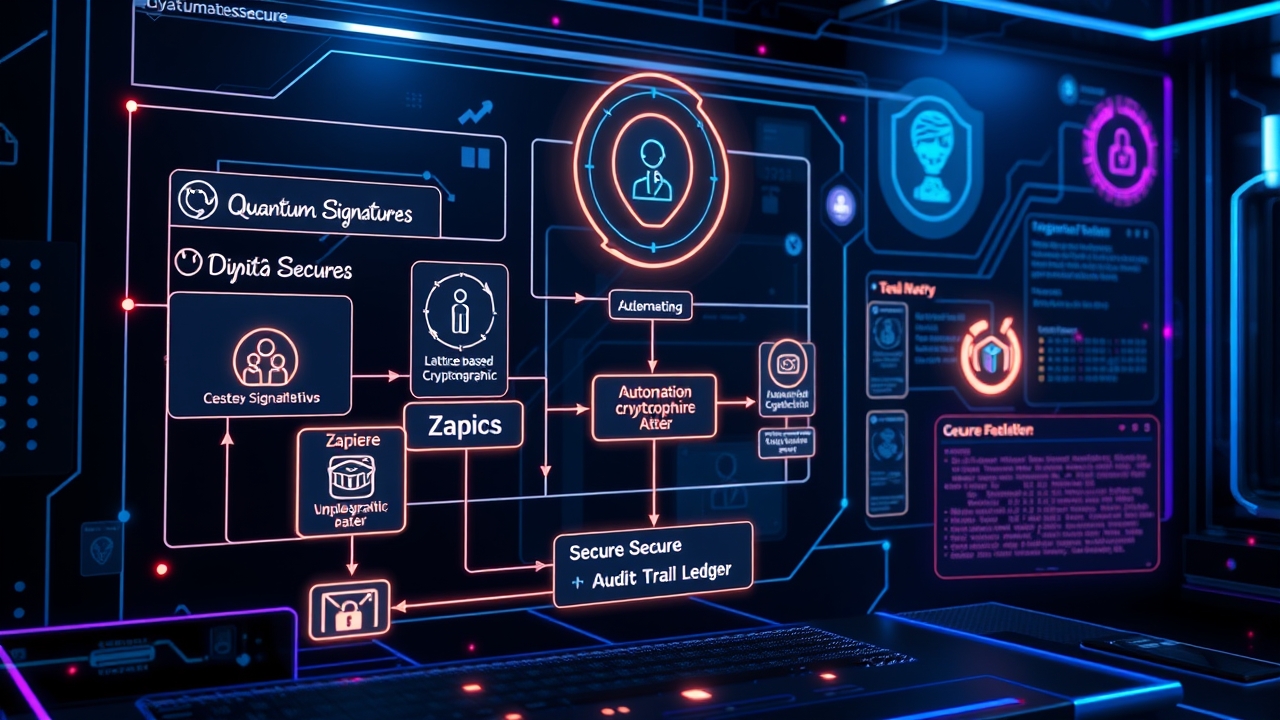
- Integrates seamlessly with platforms like Zapier, enabling users to add quantum-resistant signing to their existing automation chains with minimal effort.
- Supports real-time verification of signatures, reducing the risk of fraudulent or unauthorized changes in automated processes.
- Facilitates compliance with stringent regulatory requirements in industries such as finance, healthcare, and legal services by maintaining an immutable audit trail.
Step-by-Step Implementation for Zapier and AI Agent Workflows
Implementing quantum-resistant signing in your no-code AI agent integrations involves several key steps. Below is a high-level overview of the process, which can be adapted to most automation platforms. For a detailed walkthrough, refer to the technical documentation of your chosen PQC library.
1. Install a Post-Quantum Cryptography Library

   - Choose a PQC library that supports ML-DSA, such as Open Quantum Safe (liboqs) or Microsoft’s PQCrypto.

   - Integrate the library into your automation platform’s runtime environment.
2. Generate Quantum-Resistant Key Pairs
- Use the library to generate a public-private key pair based on the ML-DSA algorithm.
- Store the private key securely using a hardware security module (HSM) or a trusted key management system.
3. Sign AI Agent Actions
- Modify your AI agent’s workflow to include signature generation for critical actions (e.g., data processing, decision-making).
- Use the ML-DSA library to sign the output of the AI agent before sending it to the next step in the workflow.
4. Verify Signatures in Real Time
- Implement a verification step in your automation chain to ensure that signatures are valid and have not been tampered with.
- Use the public key to verify the signature and log the results for audit purposes.
5. Maintain an Immutable Audit Trail
- Store all signed actions, verification results, and timestamps in a secure, append-only ledger (e.g., blockchain or database with write-once-read-many (WORM) capabilities).
- Ensure that the audit trail is accessible for compliance reporting and regulatory audits.
Real-World Use Cases for Quantum-Secure Workflow Automation
- Finance: Automated fraud detection systems can use ML-DSA to sign transaction alerts, ensuring that fraudulent activities are detected and logged in real time with verifiable proof.
- Healthcare: Patient data processing workflows can sign electronic health records (EHRs) to maintain data integrity and comply with HIPAA regulations.
- Legal Services: Automated contract review tools can sign document modifications, providing a tamper-proof record of changes and approvals.
- Supply Chain: IoT-enabled supply chain management systems can sign sensor data and logistics updates, ensuring that the entire chain remains verifiable and resistant to counterfeiting.
- E-commerce: Order processing and inventory management workflows can sign transactions and updates, reducing the risk of fraud and chargebacks.
Overcoming Challenges in Quantum-Secure Automation Adoption
While the benefits of quantum-resistant workflow automation are clear, organizations may face challenges in adoption, such as the learning curve associated with PQC, integration complexities, and performance overhead. To address these challenges, start with a pilot project focused on a high-impact use case, such as securing a critical AI agent workflow in a regulated industry. Collaborate with cybersecurity experts to ensure proper implementation and leverage pre-built PQC integrations where available (e.g., plug-ins for Zapier or Zapier alternatives). Additionally, monitor advancements in PQC standards and tools to stay ahead of evolving threats and regulatory requirements.
Future-Proofing Your Automation Strategy with PQC
The transition to post-quantum cryptography is not just a security measure—it’s a strategic move to future-proof your automation infrastructure. As quantum computing capabilities grow, businesses that adopt PQC early will gain a competitive advantage by ensuring the long-term integrity and trustworthiness of their automated workflows. Start planning your PQC migration today by evaluating your current cryptographic dependencies, identifying critical workflows, and partnering with experts to implement quantum-resistant solutions.
Best Practices for Maintaining Quantum-Secure Workflows
- Regularly update your PQC libraries and algorithms to align with the latest NIST-approved standards and recommendations.
- Conduct periodic security audits to identify vulnerabilities in your quantum-resistant workflows and address them proactively.
- Educate your team on the importance of post-quantum cryptography and provide training on secure implementation practices.
- Monitor quantum computing advancements and adjust your cryptographic strategy accordingly to stay ahead of potential threats.
- Implement multi-layered security, combining PQC with other security measures such as zero-trust architecture and least-privilege access controls.
Keywords:
post-quantum cryptography, workflow automation, no-code AI agents, ML-DSA, quantum-resistant signing, Zapier automation, AI workflow security, cryptographic proof, real-time verification, audit trails, regulated environments, quantum computing threats, AI agent integrations, cybersecurity automation, data integrity,