
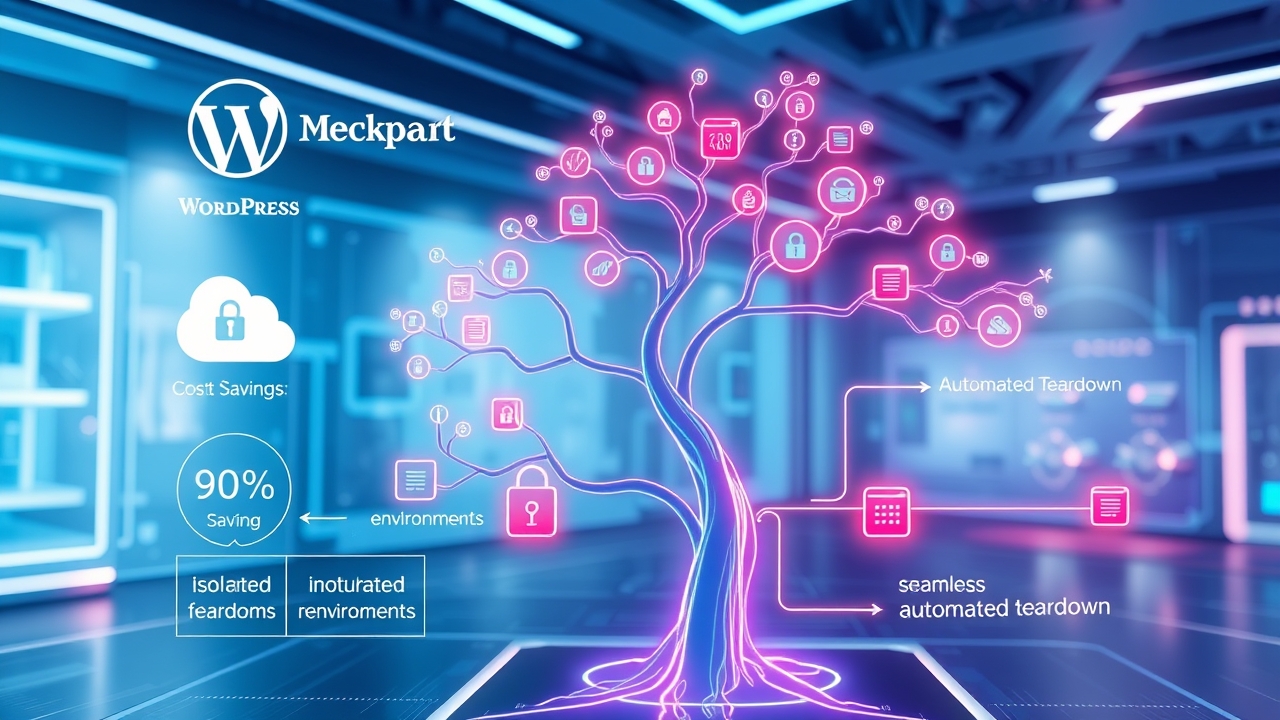
Introduction to Branch-Scoped Storage and Its Impact on Preview Environments
Branch-scoped storage represents a paradigm shift in how development teams manage preview environments, particularly in WordPress automation. Traditional preview setups require creating isolated storage buckets for each pull request (PR), assigning unique IAM roles, and ensuring proper teardown to avoid cost overruns. This process is not only cumbersome but also introduces significant overhead, delays, and potential security risks. Branch-scoped storage, leveraging technologies like Neon’s copy-on-write (CoW) storage, eliminates these challenges by providing on-demand, isolated storage environments that scale seamlessly with your development workflow. Unlike conventional methods, branch-scoped storage does not require pre-provisioning or manual cleanup, making it an ideal solution for teams looking to optimize their CI/CD pipelines while reducing infrastructure costs.
The Challenges of Traditional Preview Environments in WordPress Automation
- Per-PR bucket provisioning: Creating and managing separate storage buckets for each PR is time-consuming and error-prone, often leading to delays in deployment.
- IAM role complexity: Assigning and managing IAM roles for each isolated environment adds administrative overhead and increases the risk of misconfigurations.
- Teardown failures: Manual cleanup processes frequently fail, leaving orphaned resources that incur unnecessary costs and pose security risks.
- Cost inefficiencies: The overhead of maintaining isolated environments—even temporarily—drives up infrastructure expenses significantly.
- Scalability limitations: Traditional setups struggle to handle large numbers of concurrent PRs, especially in high-traffic WordPress projects.
How Branch-Scoped Storage Works: A Deep Dive
Branch-scoped storage operates on the principle of copy-on-write (CoW), a technology that allows for the instant creation of isolated storage environments without duplicating data. When a new branch or PR is created, branch-scoped storage generates a lightweight snapshot of the existing storage, which serves as the base for the preview environment. Any changes made in the preview environment are written to a new layer, leaving the original data intact. This approach ensures that each environment is completely isolated, secure, and free from interference with other branches or the main production environment.
Example: Neon’s CoW Storage Implementation for Branch-Scoped Environments

# Create a new branch-scoped storage environment

POST /v1/projects/{project_id}/branches

{

  "name": "feature/login-page",

  "parent_id": "main",

  "source_branch": "main",

  "type": "branch"

}
# Automatically provisioned storage with isolated access
GET /v1/projects/{project_id}/branches/{branch_id}/storage
{
"endpoint": "https://feature-login-page.storage.neon.tech",
"credentials": {
"username": "feature-login-page",
"password": "generated-secret-key"
}
}
Integrating Branch-Scoped Storage with CI/CD Pipelines in WordPress
Integrating branch-scoped storage into your CI/CD pipeline involves configuring your automation tools to interact with the storage provider’s API. Most modern CI/CD platforms, such as GitHub Actions, GitLab CI, or Jenkins, can be easily adapted to support branch-scoped storage. The process typically involves creating a new branch in the storage system whenever a new PR is opened, attaching the storage credentials to the environment variables of the CI/CD job, and deploying the WordPress preview site to the isolated storage endpoint. Once the PR is merged or closed, the branch-scoped storage environment is automatically torn down, ensuring no residual costs or security vulnerabilities.
- Configure CI/CD workflows to trigger branch-scoped storage creation on PR open.
- Use environment variables to pass storage credentials securely to the preview environment.
- Deploy WordPress to the isolated storage endpoint using automation scripts or plugins.
- Automate the teardown process to remove the branch-scoped storage when the PR is merged or closed.
- Monitor costs and performance to ensure optimal resource utilization.
Reducing Infrastructure Costs by 90% with Branch-Scoped Storage
One of the most compelling advantages of branch-scoped storage is its ability to drastically reduce infrastructure costs. Traditional preview environments require dedicated storage buckets, each incurring costs for storage, IAM policies, and network egress. In contrast, branch-scoped storage leverages CoW technology to create lightweight, ephemeral environments that share the same underlying data. This means you only pay for the differential storage needed for changes, rather than the entire dataset. For teams managing hundreds or thousands of PRs, this can translate to cost savings of up to 90%, freeing up budget for other critical development initiatives.
Security and Isolation Benefits of Branch-Scoped Environments
Security is a paramount concern in any development workflow, especially when dealing with preview environments that may contain sensitive data or expose vulnerabilities. Branch-scoped storage addresses these concerns by providing complete isolation between environments. Each preview environment operates in its own namespace, with unique credentials and access controls, ensuring that no data leaks between branches. Additionally, the ephemeral nature of these environments means that sensitive data is automatically purged once the PR is closed, reducing the attack surface and compliance risks.
- Complete isolation: No data sharing between branches or with the production environment.
- Unique credentials: Each environment has its own access keys, reducing the risk of credential leaks.
- Automated cleanup: Orphaned environments are automatically removed, eliminating security vulnerabilities.
- Compliance-friendly: Meets strict data protection requirements by ensuring no residual data remains after teardown.
- Reduced attack surface: Minimizes the risk of exposing vulnerabilities in preview environments.
Step-by-Step Guide to Implementing Branch-Scoped Storage in WordPress
Implementing branch-scoped storage in a WordPress project involves several key steps, from selecting a compatible storage provider to configuring your CI/CD pipeline. Below is a step-by-step guide to help you get started. This process assumes you are using a storage provider that supports CoW technology, such as Neon, and a CI/CD platform like GitHub Actions.
- Choose a branch-scoped storage provider: Evaluate providers like Neon, which offer CoW storage with seamless CI/CD integration.
- Set up your WordPress project: Ensure your WordPress site is compatible with the storage provider’s API and automation tools.
- Configure your CI/CD pipeline: Modify your existing pipeline to create branch-scoped storage environments on PR open events.
- Deploy WordPress to the isolated storage: Use automation scripts to deploy your WordPress site to the new storage endpoint with the provided credentials.
- Test the preview environment: Verify that the isolated environment works as expected and is fully functional.
- Automate teardown: Configure your pipeline to remove the branch-scoped storage environment when the PR is merged or closed.
Best Practices for Managing Branch-Scoped Storage in WordPress Automation
To maximize the benefits of branch-scoped storage, it’s essential to follow best practices that ensure efficiency, security, and cost-effectiveness. Start by standardizing the naming conventions for your branch-scoped storage environments to avoid confusion and simplify management. Implement monitoring and alerting to track storage usage, costs, and performance, ensuring you stay within budget and can quickly identify any issues. Regularly review your CI/CD pipeline configurations to ensure they align with your storage provider’s latest features and updates. Finally, document your processes and train your team to ensure smooth adoption and minimize human error.
- Standardize naming conventions for branch-scoped environments to simplify management.
- Implement monitoring and alerting to track storage usage and costs in real-time.
- Regularly review and update your CI/CD pipeline configurations to leverage new features.
- Document your processes and train your team to ensure consistent adoption and reduce errors.
- Use automation to enforce security policies, such as credential rotation and access controls.
Comparing Branch-Scoped Storage with Traditional Preview Environments
When evaluating branch-scoped storage against traditional preview environments, the differences in efficiency, cost, and scalability are stark. Traditional setups require significant manual intervention, from provisioning storage buckets to managing IAM roles and handling teardown failures. Branch-scoped storage, on the other hand, automates these processes, reducing human error and operational overhead. While traditional environments may offer more control over individual components, they lack the scalability and cost-efficiency of branch-scoped storage. For teams looking to streamline their WordPress automation workflows, branch-scoped storage is a clear winner in terms of both performance and ROI.
- Traditional environments: High overhead, manual processes, higher costs, and scalability limitations.
- Branch-scoped storage: Zero infrastructure overhead, automated processes, up to 90% cost reduction, and seamless scalability.
- Best for small teams: Traditional environments may suffice for small-scale projects with minimal PRs.
- Best for large teams: Branch-scoped storage is ideal for teams managing hundreds of PRs or large WordPress multisite networks.
Future Trends: The Evolution of Preview Environments in WordPress Automation
The future of preview environments in WordPress automation is closely tied to advancements in storage technology and automation tools. Branch-scoped storage is just the beginning; we can expect to see even more innovative solutions that further reduce overhead and costs while enhancing security and scalability. Emerging trends include AI-driven environment management, which uses machine learning to optimize storage allocation and predict resource needs, and serverless architectures that eliminate the need for traditional storage buckets altogether. As these technologies mature, branch-scoped storage will likely become the standard for WordPress automation, offering unparalleled efficiency and flexibility for development teams worldwide.
Keywords:
branch-scoped storage, preview environments, WordPress automation, CI/CD pipelines, Neon storage, cost reduction, infrastructure overhead, copy-on-write storage, isolated environments, DevOps automation, zero-infrastructure setup, per-PR environments, AWS S3 alternatives, environment isolation, automated teardown,





